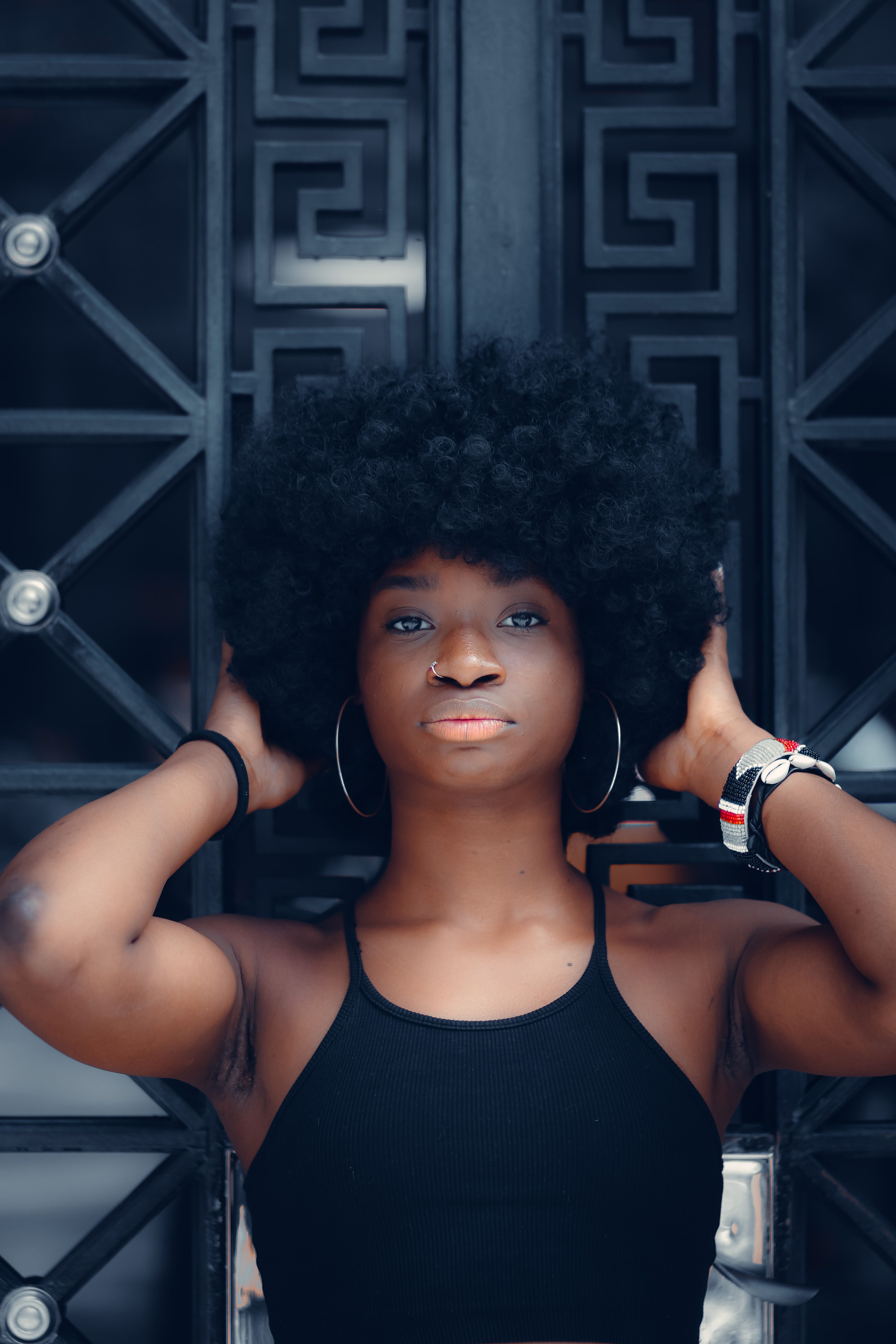
For women – and Black women in particular – hair might be one of the most elaborate languages we speak without opening our mouths.
Some wear their coils and curls like a crown. Others prefer 40 inches, bone straight, middle part, buss down to the gods. Some will happily give you both before the month is out.
Personally, I don't care.
I'm less interested in how you wear your hair than I am in whether you're using it for expression or suppression.
Because those are two very different things.
Hair can be play. Armour. Politics. Heritage. Sex. Status. Rebellion. Camouflage. Sometimes it's just what looked cute on Pinterest at 1am.
And sometimes it's a negotiation.
How much of myself can I bring into this room?
Will they think my hair is professional?
Am I straightening my 4C curls because I fancy something different or because somewhere along the way I learnt that this version of me goes down easier?
If I straighten it, am I betraying something?
If I wear it natural, is that actually what I want today, or am I carrying the politics of everybody who came before me on my scalp?
That's a lot of responsibility for a follicle.
Then there are the women who look in the mirror – whatever their mane choice – and see some deepest part of their inner beauty reflected back at them in 4K.
And others who are still trying to untangle the shoulds, should-nots and knots.
That's where hair starts getting interesting to me.
Because I've begun to wonder whether the difficulty some of us have expressing ourselves through our hair shows up elsewhere too.
If you're constantly editing what happens on your head, what happens when it's time to open your mouth?
Does your voice get the corporate silk press too?
Do the words become as carefully constructed as the hairstyle?
And underneath all of that grooming, polishing and performing, where exactly did you go?
HAIR HAS ALWAYS HAD A SIDE HUSTLE
Of course, hair has never been allowed to just be hair.
Across cultures and spiritual traditions, we've cut it to mark new beginnings, shaved it in devotion, covered it in reverence, grown it as an expression of faith, mourned its loss and changed it when we were quite clearly about to change our lives.
A breakup pixie cut has probably announced more rebirths than a new moon ever could.
Metaphysically, things get even juicier.
Hair is often described as an antenna through which we receive, transmit and interact with the world around us. Honourable shoutout to my hairy armpit and coochie crew.
Whether you believe your follicles are picking up messages from a higher source is entirely your business.
But hair absolutely communicates.
Before you've said a word, it can tell the room something about your culture, your politics, your religion, your relationship with femininity or masculinity, your appetite for attention, your willingness to conform. Or that you had £600 and an excellent frontal appointment.
So perhaps the more interesting question isn't whether hair can send and receive messages.
It's what message yours has been given.
Because this is where things got interesting with one of my clients.
THE HOLOGRAM
She came to me believing she was showing up authentically.
I didn't buy it.
What I was meeting felt more like a very convincing hologram she'd created while the fullest version of her was somewhere in the background playing hide and seek.
She had a big complex.
Not a superiority complex. A big complex.
She believed she was too big for the spaces she entered. Too loud. Too visible. Too much.
Just… too.
So she'd learnt to shrink like 4C hair after a dip in the pool.
Still cute. Still very much there. But pull gently on one strand and suddenly you realise just how much length has been hiding in plain sight.
That was her.
Over time, we started uncovering the quiet contracts she'd signed with herself: don't outshine. Don't take up too much room. Don't make other people uncomfortable. Don't let them see the full extent of you.
And somewhere amongst all of this, she'd also mentioned something else.
Her hair wouldn't grow.
She was dealing with ingrown hairs too.
I'm a metaphysicist and I'm not going to pretend otherwise just because we've reached the part of the story that some people might scratch their chins at.
I’m not a trichologist so I’m not going to diagnose the health of her hair, and I'm not suggesting that a suppressed personality medically causes ingrown hairs or prevents hair growth.
But I could not ignore the metaphor sitting in front of me.
Here was a woman who had spent years training her expression not to extend too far beyond herself.
And here was her hair seemingly doing the same thing.
Instead of travelling outwards, some of it was turning back in.
The rest, according to her, simply wasn't getting anywhere.
SO WE WORKED ON OUT
We used breath to disturb some of what she'd become very good at holding in place.
We used the body to give all that personality somewhere larger to live.
And we used sound. Actual sound.
Because at some point you have to hear yourself, bitch. Otherwise how is anybody else supposed to?
She made noise and took up space.
She practised inhabiting the body she'd previously been trying to make smaller. We started dismantling the hologram and giving the louder, brighter, more visible woman who had been bursting at the seams somewhere to go.
After about eight weeks I noticed her hair was swinging.
I mentioned it.
She blushed.
She'd noticed too.
She also reported that the ingrown hairs had reduced. And, interestingly, she began noticing that when she slipped back into periods of suppressing herself, they were more likely to make an appearance.
Is that clinical proof that self-expression controls hair growth?
Of course not.
One client is not a laboratory and correlation does not magically become causation because the metaphor is sexy as fuck.
But I'm also not prepared to throw away an interesting observation simply because I haven’t had it peer-reviewed by a bunch of scientists.
For her, the pattern became useful information. Her hair had become another place to notice herself.
Maybe you don't believe hair is an energetic antenna. Maybe you don't believe the body communicates symbolically at all.
Fair.
But even stripped of the metaphysics, the relationship we have with our hair is material.
We touch it, hide it, expose it, manipulate it, protect it, straighten it, extend it, cut it off and use it to negotiate how much of ourselves the outside world gets to meet.
So next time you're sitting in the chair deciding which version of yourself is leaving the salon, perhaps the question isn't natural or straight, braids or buss down, inches or coils.
Maybe it's much simpler.
Is this how I want to be seen or how I've learnt to make myself acceptable?
Your hair doesn't need to make a political statement.
But it might be worth checking that it's still allowed to make yours.